Ask ten transporters how long a truck takes from Hyderabad to Pune and you will get ten answers, most of them optimistic. We wanted a number we could plan with, so we measured it — on every trip our own trucks ran between August and mid-November 2026.
This article shares those numbers: 1,169 trips on 10 two-way routes across 8 states, all run by our own 19 T and 28 T trucks. If you are planning a supply chain, choosing a transport vendor or setting delivery promises, these are the figures we would want in your hands.
How we measured
Every trip in our system has two clocks:
- Dispatch — the moment the trip was created in the client’s system. This is when the clock starts, even if the truck is still being loaded.
- Arrival — when the truck’s own GPS track entered the destination hub, or the trip was closed.
The time between them is the transit time. It includes everything a real trip includes: loading time after dispatch, halts at touching points on the way, toll plazas, city entry restrictions and the driver’s rest stops.
For each route and direction we report the median: half of the trips were faster and half slower. We also looked at the middle half of trips (from the 25th to the 75th percentile), because the spread tells you more than the average does about how much buffer you need.
The numbers
| Route | Distance | Going | Return | Trips |
|---|---|---|---|---|
| Hyderabad ⇄ Visakhapatnam | 610 km | 15 h 36 min | 15 h 24 min | 159 |
| Hyderabad ⇄ Pune (Chakan) | 604 km | 18 h 24 min | 19 h | 148 |
| Hyderabad ⇄ Hosur | 705 km | 19 h 12 min | 21 h 6 min | 144 |
| Hyderabad ⇄ Vapi | 905 km | 26 h | 26 h 48 min | 184 |
| Hyderabad ⇄ Vadodara | 1,139 km | 30 h 48 min | 30 h 54 min | 51 |
| Hyderabad ⇄ Bhubaneswar | 1,090 km | 31 h 30 min | 31 h 12 min | 71 |
| Chennai ⇄ Vapi | 1,440 km | 43 h 12 min | 40 h 24 min | 97 |
| Dhule ⇄ Goa (Panaji) | 852 km | 27 h 12 min | 26 h 30 min | 150 |
| Chh. Sambhajinagar ⇄ Salem | 1,197 km | 31 h 48 min | 32 h 48 min | 70 |
| Chh. Sambhajinagar ⇄ Dhule | 224 km | 7 h 6 min | 7 h | 95 |
Median distance and median dispatch-to-arrival time, August–November 2026. The same table, kept up to date, is on our network page.
Finding 1: plan with 32–40 km/h, not highway speed
Divide distance by transit time and every route lands between 31 and 40 km/h door to door. The fastest is Hyderabad to Visakhapatnam at about 39 km/h; the slowest are the ghat-heavy Dhule–Goa run and the short Sambhajinagar–Dhule hop at about 31–32 km/h.
A loaded truck cruises at 50–60 km/h on a good highway, which is why quotes built on highway speed are so often wrong. The difference is everything that is not driving: the wait after dispatch, the touching points, tolls, city no-entry hours, meals and sleep. For planning, divide the road distance by 35 and you will be close on most Indian long-haul routes.
Finding 2: distance does not decide how predictable a route is
You might expect longer routes to be less predictable. Our data says otherwise.
- Hyderabad ⇄ Bhubaneswar (1,090 km): the middle half of trips fell inside a window of less than one hour, both ways.
- Hyderabad ⇄ Vadodara (1,139 km): a window of about 1 h 20 min.
- Chennai → Vapi (1,440 km): the middle half spread across 13 hours — from 39 h 18 min to 52 h 18 min.
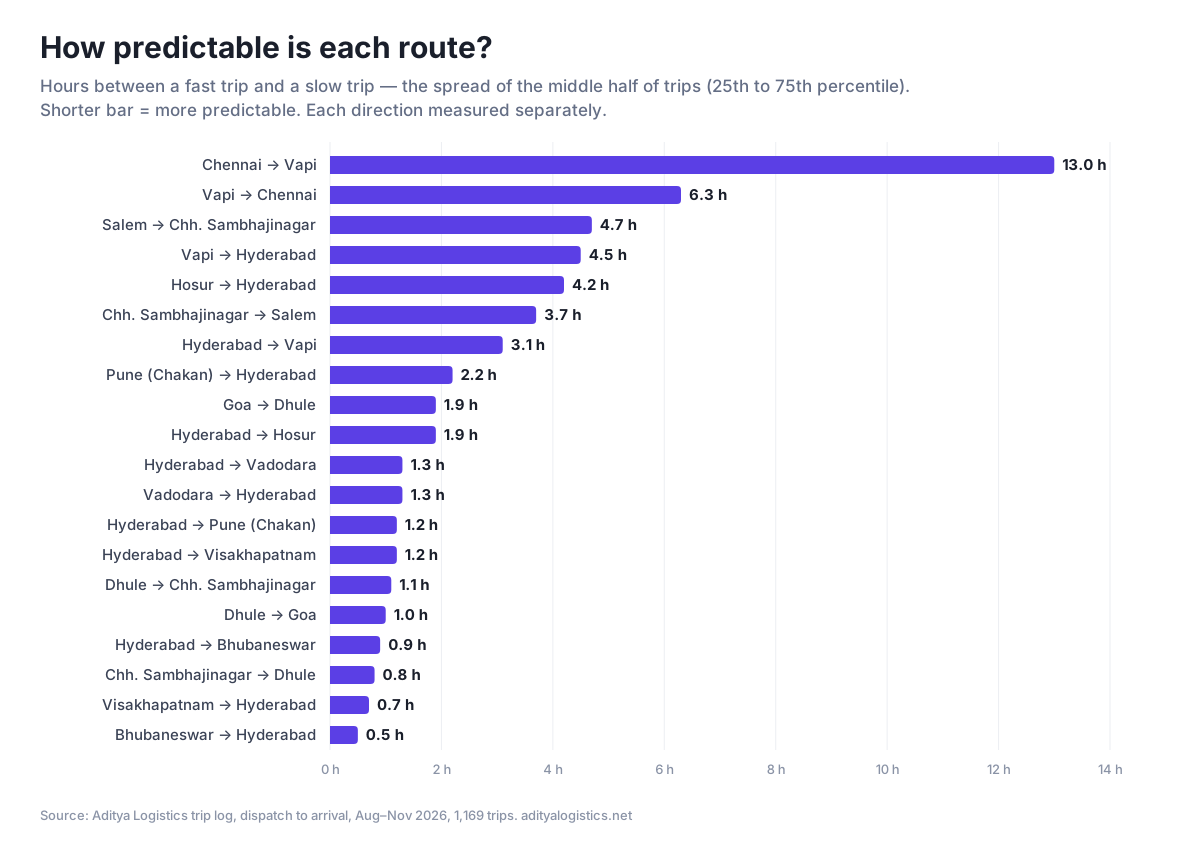
What makes the difference is not kilometres but stops and corridors. Chennai to Vapi crosses four states, runs through the busy Bengaluru–Pune–Mumbai belt and has touching points on the way, where a truck can be held for hours. A route with fewer hubs and an open highway behaves like clockwork even at 1,000 km and more.
For buyers: ask a vendor for the spread, not just the average. A route with a 13-hour spread needs a very different buffer from one with a one-hour spread.
Finding 3: direction matters
Several routes are clearly faster one way than the other:
- Hosur → Hyderabad takes about 2 hours longer than Hyderabad → Hosur.
- Chennai → Vapi takes about 3 hours longer than Vapi → Chennai.
- Vapi → Hyderabad takes about 50 minutes longer than the reverse, and its slow trips run much later than its fast ones.
Same road, same trucks, same drivers. The difference comes from when the trip starts: departure times decide whether a truck reaches a city during its no-entry hours, whether the long night stretch falls on an open highway or a congested one, and how long it waits at a touching point that is busy at that hour. A schedule that ignores direction will be late in one direction every day.
Finding 4: traffic is rarely the problem — halts are
We looked closely at the Chennai → Vapi route, the slowest and least predictable of our routes. When the truck was moving, it moved steadily: the driving time on a typical run was about 32½ hours. The rest of the trip was standing time — overnight halts at roadside dhabas, trucks held at hubs on the way, and the occasional long stand after a problem on the road.
This matches what our alert system sees across the fleet. A traffic jam costs an hour; an unplanned halt at night can cost five. That is why our technology treats them differently: a truck creeping forward with its engine on is in traffic and nobody is called, while a truck standing 45 minutes away from any hub on its route raises an alert — and keeps raising it every 15 minutes until it moves.
What this means if you are planning freight
- Start the clock at dispatch, not departure. The paperwork is often made before the truck is loaded. If your promise counts from dispatch, the loading time is inside it.
- Use the median plus the spread. On a tight route, add an hour. On a wide one, add the spread or plan a later cut-off.
- Plan each direction separately. The return run is not the same trip backwards.
- Watch halts, not speed. Speed limits keep trucks safe; halts are where the hours disappear.
- Ask your vendor for their own numbers. Any transporter with GPS on its trucks can produce a table like the one above. If they cannot, they are guessing too.
About this data
The data comes from our own trip log: trips run by Aditya Logistics trucks between August and mid-November 2026 that have a recorded arrival. Distances are road distances from the trip record. We will update these figures as more trips come in — the network page always has the latest table.
If you want transit figures for a route we run, or want us to study a new one, send us the route.

Written by the people who dispatch, track and settle our trucks every day, from our own trip data. Questions or corrections: info@adityalogistics.net.